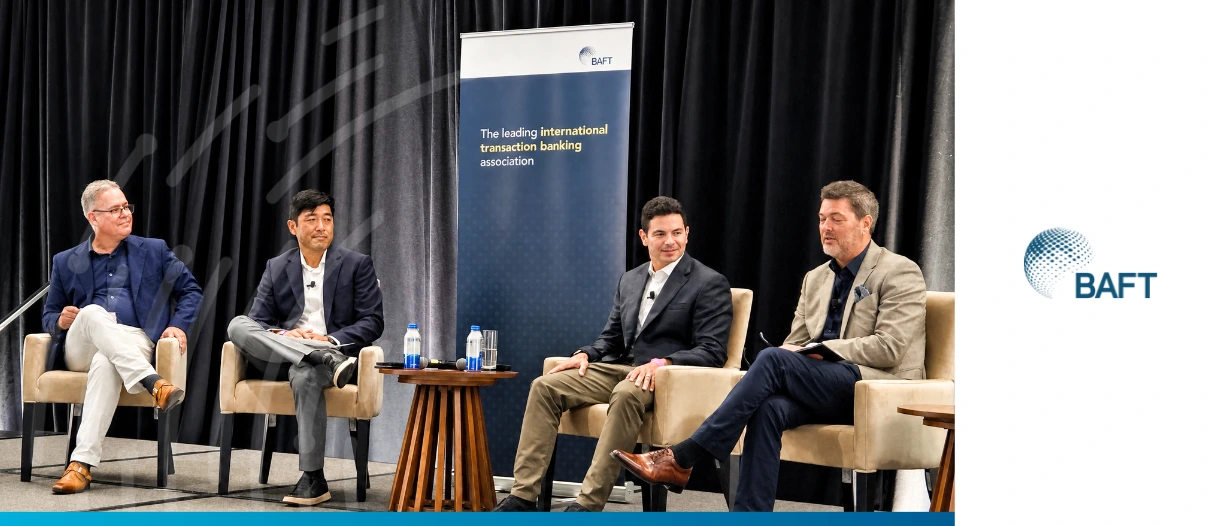
Banks seeking to enter the US payments market need to accommodate established methods such as paper cheques alongside newer digital channels, executives told the BAFT 2026 Global Councils Forum. According to Trade Finance Global’s coverage, speakers stressed that customer habits, compliance requirements and differing cash-flow priorities should shape banks’ expansion strategies rather than a uniform approach to payment technology.
Ray Chalub, chief operating officer and US branch general manager of Banco Inter, said the bank had underestimated Americans’ continued use of cheques. Customer cheque deposits through its mobile app reached around 10,000 a day, Trade Finance Global reported. He also highlighted the popularity of automated clearing house, or ACH, transfers for their reliability, efficiency and low cost. Different transactions require different channels, he argued, with a house purchase creating a need for a wire transfer that may rarely arise in everyday banking.
Corporate customers are also seeking payment experiences closer to those they encounter as consumers. Marc Pettican, global head of corporate solutions at Mastercard, linked that shift partly to younger users accustomed to contactless transactions. He advocated systems capable of moving between payment channels as buyers’ and suppliers’ needs change. A transaction could, for example, use a card network at one point in the month and ACH later, depending on the buyer’s working-capital requirements.
Regulatory obligations remain central to expansion. Mario Fujii, chief executive of BB Americas Bank, described avoiding regulatory problems as his foremost instruction when taking on his mandate. He recalled discussions with senior Federal Reserve and Treasury officials in Washington in 2022 about newly introduced Russia-related sanctions, including restrictions affecting correspondent accounts and transaction processing for designated financial institutions. Chalub separately called for greater connectivity between national payment systems, citing India’s UPI, Brazil’s Pix and Poland’s BLIK.
Technology partnerships can help banks add capabilities, but integration risks undermining the flexibility that makes fintech businesses attractive. Pettican recalled an integration in which more than 200 internal policies could have applied to the acquired business; the team instead settled on 20 to avoid constraining it. The discussion underscored the need to balance adaptable payment services with the controls and local knowledge required to operate in a new market.