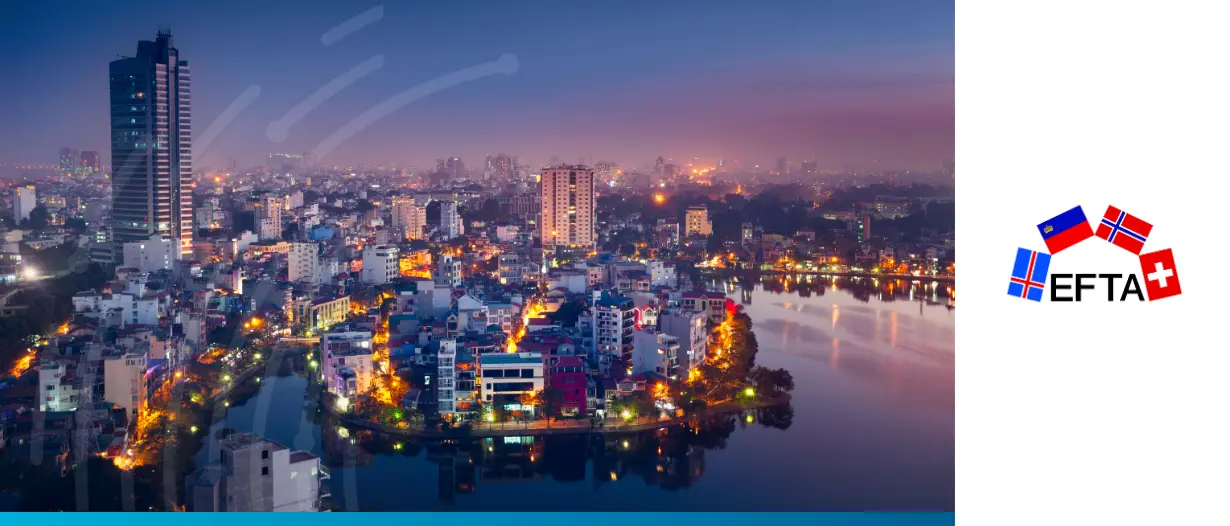
Iceland, Liechtenstein, Norway and Switzerland have signed a free trade agreement with Vietnam that will progressively remove tariffs on almost all their existing exports to the country, Trade Finance Global reported. The four European Free Trade Association (EFTA) members signed the pact in Hanoi on 18 October, following negotiations that began in 2012 and resumed in September 2025 after a pause.
The tariff timetable varies across the agreement. Citing the Norwegian government, Trade Finance Global said roughly half of Norway’s exports would qualify for tariff-free entry when the pact takes effect, rising to more than 98% within seven years. Vietnamese goods entering EFTA markets will receive either duty-free treatment or lower customs duties. EFTA Secretariat communications head Asdís Ólafsdóttir told the outlet that tariffs on nearly all current EFTA exports would disappear immediately or over a maximum of 16 years, opening opportunities in seafood, machinery, watches and chocolate.
The agreement extends beyond merchandise trade to services, investment, intellectual property and sustainable development. Ólafsdóttir said cheaper trade, easier customs processes and improved transparency would be particularly valuable to small and medium-sized businesses, while providing greater predictability for commercial activity and investment. Trade Finance Global reported that bilateral trade reached €4.8 billion in 2025, excluding Swiss gold trade, with Vietnam recording a €2.5 billion surplus. Electrical machinery and fish were among the EFTA exports showing substantial growth.
EFTA’s members are outside the European Union and conduct trade negotiations separately from the bloc, despite having partial access to its single market through the European Economic Area agreement or bilateral arrangements. The EU’s own trade agreement with Vietnam has been in place since 2020. Vietnam is the sixth member of the Association of Southeast Asian Nations to sign an EFTA free trade pact.
The deal comes as Vietnam seeks a broader range of trading partners amid tariff uncertainty and efforts by Western economies to reduce dependence on China. Trade Finance Global said the Vietnamese government presented the agreement as support for a rules-based trading system during global economic instability, alongside its role in strengthening Vietnam’s participation in international supply chains.